

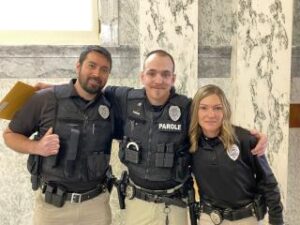
Probation & Parole

Probation & Parole OfficersProbation & Parole is made up of outstanding people whose focus is public safety. Public safety is best achieved when those under the jurisdiction of Probation & Parole change their behavior.  Our approach to behavior change is by doing this work as a “coach” vs. “referee.” The structure or make-up of Idaho’s Probation & Parole system, consists of managers, supervisors, officers, investigators, specialists, reentry specialists, clinical staff, case managers, program and support staff across the state working in District Offices, Community Reentry Centers and Central Office. The staff provide services to nearly 16,000 clients either on probation or parole. 

What is Probation?

When a person is convicted of a felony, the Judge can sentence them to a term of incarceration, or suspend that sentence, and allow the person to remain in the community under probation supervision with Probation & Parole. Clients are then assigned to a probation officer whose work is to help the client be successful not only with the terms and conditions of their probationary term, but successful in life.  The District Courts govern all probation conditions.

What is Parole?

When a person is sentenced to prison in Idaho, they are given a fixed period of time, followed by an indeterminate period of time to complete. Parole may be granted at any time during the indeterminate period of time by the Commission of Pardons & Parole. Those granted parole are then supervised by Probation & Parole Officers similar to those on probation. Parolees generally have the same terms and conditions as probationers and are required to participate in community programming.  Just like those on probation, officers “coach” the parolee to change their behavior and find success.  

Probation & Parole values

Providing opportunities for people on probation or parole supervision to change their behavior, and find success is possible because of our core values. Honesty, professional behavior, exercising authority consistent with the constitution, developing positive rapport with clients, the public and other agencies provide the foundation for Idahoans to have confidence in what we do.

Coach vs. Referee

The Idaho Department of Correction is evolving from a traditional “referee” role to a more supportive “coach” approach to improve client outcomes. This shift involves recognizing client strengths and barriers, while equipping staff with skills that build rapport, drive behavior change, and lead to successful outcomes. By acting as a coach, probation officers aim to provide the necessary support and guidance to help clients thrive as they reintegrate into the community.

  • A coach helps clients improve and sets them up for success.
  • A coach recognizes strengths and barriers.
  • A coach focuses on the future.
  • A coach incorporates skills and behavior changes for success.